Pathways and legs
A pathway is a way to move money from the user to the destination. It has one or two legs. Each leg is run by one adapter.
Examples:
| Pathway | Legs |
|---|---|
| Card to USDC on Base | swapped.creditcard (card -> USDC on Base) |
| VietQR to a token on Monad | swapped.vietqr (VND -> USDC on Base), then relay.bridge (USDC on Base -> token on Monad) |
| QRIS to your merchant account | xendit.id-qris (IDR -> your IDR balance) |
| Pay from a wallet | relay.wallet (any token in the wallet -> destination token) |
| Withdraw USDC on Base to an Arbitrum address | relay.wallet (USDC on Base -> USDC at the address on Arbitrum) |
| Withdraw USDC to a bank account in EUR | swapped.sell-bank-transfer (USDC -> EUR in the user's account) |
Assets, locations and endpoints
The planner matches legs by endpoints. An endpoint is an asset at a location.
type Asset =
  | { kind: 'fiat'; currency: string }                                   // ISO 4217, e.g. 'VND'
  | { kind: 'crypto'; chain: string; token: string; symbol?: string; decimals?: number }
                                                                          // CAIP-2 chain, token address or 'native'
type Location =
  | { kind: 'user_wallet' }        // a wallet the user controls
  | { kind: 'user_account' }       // the user's bank, card or e-wallet
  | { kind: 'merchant_account'; accountRef?: string }
  | { kind: 'address'; address: string }

type Endpoint = { asset: Asset; location: Location }
Money values are decimal strings everywhere ('12.5'), never floats. Chains are CAIP-2 ids (eip155:8453 is Base). Countries are ISO 3166-1 alpha-2 (VN).
Destination
For a deposit, your backend sets the destination when it creates the session. For a withdrawal, the user picks it (the target), and the server stores it as the destination.
type Destination =
  | { type: 'crypto'; chain: string; token: string; address: string; symbol?: string; decimals?: number;
      calls?: ContractCall[]; settlement?: { contract: string } }
  | { type: 'merchant'; currency: string; accountRef?: string }
  | { type: 'fiat'; currency: string } // withdraw to cash
The planner turns it into the target endpoint:
- crypto:
{ asset: { kind: 'crypto', chain, token }, location: { kind: 'address', address } } - merchant:
{ asset: { kind: 'fiat', currency }, location: { kind: 'merchant_account' } } - fiat:
{ asset: { kind: 'fiat', currency }, location: { kind: 'user_account' } }
settlement sends the payment through an on-chain settlement contract, and calls runs contract calls after delivery (for example a vault deposit). calls needs settlement. See On-chain settlement.
Leg specs
Each adapter declares its legs as data. The planner reads only these declarations.
type LegSpec = {
  id: string                    // unique within the adapter
  kind: 'fiat_onramp' | 'fiat_payin' | 'wallet_transfer' | 'bridge_swap'
      | 'crypto_withdraw' | 'crypto_offramp' | 'fiat_payout'
  methods?: string[]            // user-facing methods, e.g. ['card', 'apple_pay'] or ['vietqr']
  from: EndpointMatcher         // what it takes
  to: EndpointMatcher           // what it delivers
  regions: { allow: string[]; deny: string[] }
  limits?: { min?: string; max?: string; currency: string }  // a hint; quotes carry exact limits
  eta: { min: number; max: number }                          // seconds
  surfaces: SurfaceKind[]
  requires?: Array<'provider_account' | 'provider_kyc' | 'wallet' | 'otp'>
  capabilities?: Array<'settlement' | 'surface_after_processing'>  // see below
}

type EndpointMatcher = {
  asset:
    | { kind: 'fiat'; currencies: string[] | '*' }
    | { kind: 'crypto'; chains: Record<string, string[] | '*'> | '*' }  // chain -> lowercase token addresses
  location: Array<'user_wallet' | 'user_account' | 'merchant_account' | 'address'>
}
capabilities has two values, and the server checks both. settlement: the leg can pay into an OpenRampSettlement contract; the planner offers a settlement destination only through a pathway whose last leg has it. surface_after_processing: a provider event may reopen the leg once with a new surface (see Flow). How the server learns a leg result is not a capability: it comes from the adapter's status() and webhook.
An adapter may also have a live catalog(). The server calls it at plan time with the user's country and currency, and uses the returned legs instead of the static ones. If the catalog fails, the server logs a warning and falls back to the static legs.
The planner algorithm
planPathways(input) in @openrampkit/core is a pure function. The server calls it on POST /sessions/:id/plan (and on POST /sessions/:id/target for a withdrawal). This section describes deposits. Withdrawals use a simpler rule: see Withdraw planning.
- Currency. For a merchant or fiat destination, the currency is the destination's currency. Otherwise it is the local currency of the user's country (
currencyForCountry), or USD when the country is unknown. - Sources. The user can start from two places: fiat in
user_account(in that currency), or any crypto inuser_wallet. - First legs. Every leg whose
frommatches a source is a candidate first leg. - One-leg pathways. If the first leg's
tomatches the destination endpoint, it is a one-leg pathway, once per method. - Two-leg pathways. Otherwise, and only for crypto destinations when
maxLegsis 2, the planner looks for a hop:- It lists the concrete crypto assets the first leg can deliver (it skips legs whose
tois'*'). - It sorts them by hop preference (see below).
- For the first hop asset where a
bridge_swapleg takes that asset at anaddressand delivers to the destination, it makes a two-leg pathway. It stops at the first match: one hop per first leg.
- It lists the concrete crypto assets the first leg can deliver (it skips legs whose
- Problems. A leg is marked with a reason, and the pathway goes to the "unavailable" group, when:
- the app's region policy or the leg's region policy does not allow the user (
REGION_UNSUPPORTED), - the client cannot draw any of the leg's surfaces (
CLIENT_UPGRADE_REQUIRED), - the leg requires a wallet and none is connected (
BAD_REQUEST, "Connect a wallet to use this method."), - the destination has
settlementand the last leg does not declare thesettlementcapability (PROVIDER_UNAVAILABLE, "This method cannot pay into the settlement contract.").
- the app's region policy or the leg's region policy does not allow the user (
- Methods. Methods not allowed in the user's country are dropped (see country rules). Methods in
policy.disabledMethodsare dropped. Duplicate pathway ids are dropped.
Pathway ids look like vietqr:swapped.vietqr>relay.bridge@eip155:8453: the method, the legs, and the hop chain.
Hops
The default hop preference is USDC on these chains, in order: Base, Arbitrum, Polygon, Optimism, Ethereum. Change it with policy.hopPreference in createOpenRamp (a list of CryptoAsset, most preferred first). The server passes it to planPathways.
createOpenRamp({
  // ...
  policy: {
    hopPreference: [
      { kind: 'crypto', chain: 'eip155:42161', token: '0xaf88d065e77c8cc2239327c5edb3a432268e5831' }, // USDC on Arbitrum
      { kind: 'crypto', chain: 'eip155:8453', token: '0x833589fcd6edb6e08f4c7c32d4f71b54bda02913' },  // USDC on Base
    ],
  },
})
When the pathway has two legs, the server asks the second leg's adapter for a deposit address first (prepareDeposit). The first leg then delivers into that address. For example, Relay returns an open deposit address, Swapped sends the USDC there, and Relay moves it to the destination.
Withdraw planning
A withdrawal has a fixed source (the session's source) and a target that the user picked. The planner builds one-leg pathways only. There is no hop.
- Source. The source endpoint is the source asset in the user's wallet (
user_wallet) forcustody: 'user_wallet', or at the app's address (address) forcustody: 'app'. - Legs. A leg is a candidate when all of these are true:
- its kind is
bridge_swap,crypto_withdraw,crypto_offramporwallet_transfer, - it declares the
WALLET_TXsurface (the funds leave with a signed transaction), - its
fromlocation includesuser_wallet(forcustody: 'user_wallet'), oraddressoruser_wallet(forcustody: 'app'), and itsfromasset matches the source asset, - its
tomatches the target endpoint.
- its kind is
- Problems. Region policies and client surfaces apply as for deposits. The leg's
requires: ['wallet']is not checked. Instead:custody: 'user_wallet'without a connected wallet:BAD_REQUEST, "Connect your wallet to withdraw.",custody: 'app'without atreasuryhook on the server:PROVIDER_UNAVAILABLE, "Withdrawals are not set up for this app yet.".
- Currency. For a fiat target, the currency is the target currency. For a crypto target, it is the local currency of the user's country.
In the modal, "To wallet" shows methods of kind crypto or exchange (for example wallet), and "To cash" shows the others (payout methods such as bank_transfer or gcash). The wallet method is in the recommended group.
A deposit-only leg does not show up in a withdrawal, and an offramp leg does not show up in a deposit: offramp legs start from crypto and end in a user_account.
Crypto from an exchange
The method exchange_transfer ("From an exchange") is for a user who sends crypto from an exchange account, for example Binance, Coinbase or OKX. It works like transfer:
- The leg uses the
DEPOSIT_ADDRESSsurface. The user sends any amount to the address. - The user selects the network and the token to send from. The widget does not ask for an amount.
- Its kind is
exchange. Thus, the modal shows it under "Use Crypto", and the planner never makes it the recommended cash method. - The widget tells the user to withdraw from the exchange on the network that the address shows.
isAddressTransfer(method) from @openrampkit/core is true for transfer and exchange_transfer (see ADDRESS_TRANSFER_METHODS).
An adapter offers it in the methods of a leg with the DEPOSIT_ADDRESS surface. The mock adapter offers it with exchange: true. The method exchange ("Connect exchange") is a different method: it is for a flow where the user pays from an exchange account on the exchange page, and the exchange sends the crypto. The Binance adapter offers it.
Grouping
The planner groups pathways by method and gives each method one group:
| Group | Label in the modal | Rule |
|---|---|---|
connected | Connected | The wallet method, when a wallet is connected |
recommended | Most popular | The first available fiat method in the country's priority list. Also transfer, when no wallet is connected, and wallet in a withdrawal. |
more | Other options | Every other available method |
unavailable | Not available | Methods where every pathway has a problem. The row shows the reason. |
Methods are sorted by group, then by the country's priority list, then by name.
Each available row shows the providers ("via Swapped"), the maximum limit ("$3,000 limit") and the time at the end of the row ("Instant" or "~5 min"). The time comes from the summed eta of the legs. An unavailable row shows its reason in place of these and cannot be selected.
The default priority per country (DEFAULT_METHOD_PRIORITY):
| Country | Order |
|---|---|
| ID | qris, gopay, dana, ovo, shopeepay, bank_transfer, card |
| VN | vietqr, momo, zalopay, bank_transfer, card |
| TH | promptpay, truemoney, bank_transfer, card |
| MY | duitnow, touchngo, fpx, grabpay, card |
| PH | qrph, gcash, maya, instapay, card |
| SG | paynow, card, apple_pay, google_pay |
| IN | upi, imps, card |
| BR | pix, card, mercadopago |
| CA | interac, card, apple_pay |
| US | apple_pay, card, google_pay, ach, venmo, cash_app, zelle, paypal, chime |
| GB | apple_pay, card, google_pay, faster_payments, open_banking, revolut_pay, paypal, bank_transfer |
| NL | ideal, apple_pay, card, sepa_instant, sepa, open_banking, google_pay, paypal |
| BE | bancontact, apple_pay, card, sepa_instant, sepa, open_banking, google_pay, paypal |
| DE | apple_pay, card, paypal, sepa_instant, sepa, open_banking, google_pay, sofort |
| FR, ES, IT, IE, PT, AT, FI | apple_pay, card, google_pay, sepa_instant, sepa, open_banking, paypal, revolut_pay |
| PL | blik, card, apple_pay, google_pay, open_banking, paypal |
| TR | card, apple_pay, google_pay, bank_transfer |
| MX | spei, card, apple_pay, google_pay, mercadopago, astropay |
| CO | pse, bancolombia, card, apple_pay, google_pay, mercadopago, astropay |
| CL | khipu, card, apple_pay, google_pay, mercadopago, astropay |
| AR | mercadopago, card, khipu, astropay |
| AU | payid, apple_pay, card, google_pay |
| JP | card, apple_pay, google_pay |
| KR | card, apple_pay, google_pay, bank_transfer |
| KE | mpesa, mobile_money, card, apple_pay, google_pay |
| NG | bank_transfer, card, mobile_money, apple_pay, google_pay |
| ZA | card, apple_pay, google_pay, bank_transfer |
| GH, UG, TZ, ZM, RW | mobile_money, card, apple_pay, google_pay |
| other | apple_pay, card, google_pay, sepa_instant, sepa, open_banking, bank_transfer |
Override it per country with policy.methodPriority in createOpenRamp.
Method country rules
Local methods are offered only where they exist (METHOD_COUNTRIES). A method that is not listed is offered everywhere. When the country is unknown, every method is allowed.
| Method | Countries |
|---|---|
| vietqr, momo, zalopay | VN |
| qris, gopay, dana, ovo, linkaja | ID |
| shopeepay | ID, MY, PH, TH, VN, SG |
| qrph, gcash, maya, instapay | PH |
| promptpay, truemoney | TH |
| duitnow, touchngo, fpx, boost | MY |
| grabpay | MY, SG, PH |
| paynow | SG |
| upi | IN |
| pix | BR |
| interac | CA |
| ach, venmo, cash_app, zelle, chime | US |
| mercadopago | AR, BR, CL, CO, MX, PE, UY |
| sepa, sepa_instant | Euro countries, NO, IS, LI, CH |
| faster_payments | GB |
| open_banking | GB and the EEA |
| ideal | NL |
| bancontact | BE |
| sofort | AT, BE, CH, DE, ES, IT, NL, PL |
| blik | PL |
| imps | IN |
| payid | AU |
| spei | MX |
| pse, bancolombia | CO |
| khipu | CL, AR |
| mpesa | KE |
| mobile_money | 29 countries in Africa and Asia (for example GH, UG, TZ, ZM, RW, KE) |
The payment methods page lists each method with the adapters that support it.
Region policies use ISO 3166-1 countries and ISO 3166-2 regions (US-TX). The most specific entry wins; on a tie, deny wins. An unknown country is allowed only when * is allowed and not denied.
Quoting
When the user enters an amount, the server quotes up to 5 available pathways for that method, in parallel, each with a 9 second timeout (timeouts.quote).
- Legs are quoted in order. The output of leg 1 is the input of leg 2.
- An amount on the
destinationside works only for one-leg pathways. Multi-leg pathways treat the amount as the source amount. - For a withdrawal, the first leg's source is the session
source, with the sender address: the user's wallet address, ortreasury.addressforcustody: 'app'. - A quote whose input is outside the session's
amountBoundsis dropped withAMOUNT_TOO_LOWorAMOUNT_TOO_HIGH(see Amount bounds). - A failed pathway becomes an entry in
errors, not an exception. - The combined quote sums fees and ETAs, and expires at the earliest leg expiry. Every leg quote has an
expiresAt; the server gives 5 minutes to a leg quote without a valid one. - The combined
guaranteeis the weakest of the legs (estimateis weaker thanmin_output, which is weaker thanfirm).minOutputandslippageBpscome from the last leg. See Fee and Quote. - An adapter whose recent quotes and starts mostly fail is skipped (the circuit breaker), with
PROVIDER_UNAVAILABLEinerrors. See Provider health.
rankQuotes sorts by the most delivered first, then by the fastest, then by the providers' recent success rate, then in the planner's order. It marks the first quote best_price, and the fastest one fastest when there is more than one quote.
When the chosen quote's first leg fails to start with a provider error, the server starts the next best quote of the same list (at most 2 more). See Provider health.
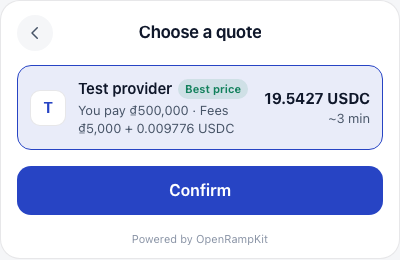
The server keeps the last 20 quotes per session. The modal re-quotes 10 seconds before the earliest expiry while the quote screen is open.