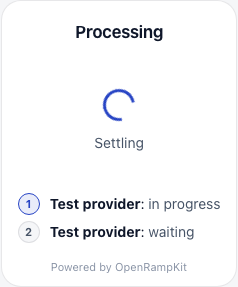
Flow state machine
The server drives the flow. Every response carries the session's current Step. The modal renders the step and fires the transitions it allows.
The Step
type Step = {
  sessionId: string
  state: StateName
  detail?: StepDetail         // a finer label: { code, providerStatus? }, e.g. { code: 'settling' }
  legIndex?: number           // which leg of the pathway is active
  surface?: Surface           // what to show: QR, redirect, deposit address, ...
  transitions: Transition[]   // what the user or the client may do next
  error?: OpenRampError
  expiresAt?: string
}
The legs, the provider order ids and the transactions of the payment are in PublicSession.payment (see Payment), not in the step.
Step detail
Step.detail is a finer label inside state:
type StepDetail = {
  code: StepDetailCode     // from the closed list STEP_DETAIL_CODES
  providerStatus?: string  // the provider's own status, for example Relay 'pending'
}
code comes from a closed list of lowercase values, STEP_DETAIL_CODES in @openrampkit/core (type StepDetailCode, check with isStepDetailCode):
code | Used in | Meaning |
|---|---|---|
kyc_details | KYC | The user gives details in a form |
kyc_terms | KYC | The user accepts the provider terms |
kyc_verify | KYC | The user verifies identity at the provider |
kyc_review | KYC | The provider reviews the identity |
card_details | PAYMENT | The user gives card details |
bank_details | PAYMENT | The user sends a bank transfer to the details shown |
payout_account | PAYMENT | The user gives a payout account |
send_crypto | PAYMENT | The user sends crypto |
waiting_for_deposit | PROCESSING | The provider waits for a deposit |
ambiguous_deposit | PAYMENT, PROCESSING | A deposit matches more than one session; an operator must check it |
confirming | PROCESSING | A transaction waits for confirmation on chain |
bridging | PROCESSING | The funds move between networks |
settling | PROCESSING | The provider settles or pays out |
delayed | PROCESSING | The provider reports a delay |
refunding | PROCESSING | The provider refunds the payment |
processing | PROCESSING | Any other provider work |
Rules:
- An adapter maps its provider statuses to this list. It puts the raw provider status in
detail.providerStatus. The server writes each new raw status to the session timeline (leg.provider_status). providerStatusis free text for display and support. The server keeps it only when it has at most 64 characters of letters, digits, spaces and_ - . :. It drops other values.- The server drops a
detailwhosecodeis not in the list, and logs a warning. - The web UI shows the label of
messages.stepDetail[code]in the user's language. Without a known code, it shows the state title.
States
| State | Meaning | Terminal |
|---|---|---|
SELECT_METHOD | No payment yet. The user picks a method, an amount and a quote. | No |
QUOTE | A quote step inside a leg | No |
AUTH | The provider needs the user to sign in | No |
KYC | The provider needs identity checks | No |
PAYMENT | The user must act: scan, pay, send, sign | No |
PROCESSING | Paid; the provider or the chain is working | No |
COMPLETED | Every leg succeeded | Yes |
FAILED | A leg failed | Yes |
EXPIRED | The session or the payment expired | Yes |
REFUNDED | The provider refunded the payment | Yes |
BLOCKED | Not allowed (policy or region) | Yes |
The table as data
The legal moves live in one table in @openrampkit/core, TRANSITION_TABLE. The server, the client and the adapter test kit all read it. Terminality comes from this table, never from counting transitions.
| From | May move to |
|---|---|
SELECT_METHOD | QUOTE, BLOCKED, EXPIRED |
QUOTE | SELECT_METHOD, AUTH, KYC, PAYMENT, PROCESSING, BLOCKED, EXPIRED |
AUTH | KYC, PAYMENT, FAILED, EXPIRED |
KYC | KYC, PAYMENT, FAILED, EXPIRED |
PAYMENT | PAYMENT, PROCESSING, COMPLETED, FAILED, EXPIRED, QUOTE |
PROCESSING | PROCESSING, PAYMENT, COMPLETED, FAILED, REFUNDED, EXPIRED |
COMPLETED | none |
FAILED | SELECT_METHOD (try again) |
EXPIRED | none |
REFUNDED | none |
BLOCKED | SELECT_METHOD |
Helpers: isTerminal(state), isLegalMove(from, to), validateStep(step), TABLE_VERSION (currently 1). isLegalMove also allows a move to the same state.
The same table as a diagram. [*] on the left is a new session. [*] on the right is a final state with no way out.
FAILED is terminal, but the table lets it go back to SELECT_METHOD: the restart transition does this after a failed attempt (session status requires_payment_method). After a final failure (session status failed), the server refuses restart. BLOCKED, REFUNDED, REVERSED and CANCELED have no way out. EXPIRED can go to PROCESSING or COMPLETED (a late payment).
Who uses the table:
- The server and the client read terminality from it (
isTerminal). A terminal step stops the poll, and the server refuses a new payment while a step is not terminal. - The adapter test kit checks each
LegStepwithvalidateStep. For example, a terminal step must not have an AWAIT transition. - The server does not reject a move that is not in the table. Adapters must return legal steps. The conformance kit helps you check this.
In practice, the server moves SELECT_METHOD straight to the first leg's state when POST /select starts the leg. QUOTE is for adapters that quote inside a leg.
Leg status
Each leg has its own LegStatus. The server gets the session state from the leg step with one rule, stateFor(step) in @openrampkit/core:
| Leg status | Session state | Final |
|---|---|---|
pending | AUTH or KYC with a phase, else PROCESSING | No |
requires_action | The action.kind: AUTH, KYC or PAYMENT | No |
processing | AUTH or KYC with a phase, else PROCESSING | No |
succeeded | COMPLETED for the last leg, else PROCESSING while the next leg starts | Yes |
failed | FAILED | Yes |
refunded | REFUNDED, or REVERSED when the leg had succeeded | Yes |
reversed | REVERSED | Yes |
expired | EXPIRED | Yes |
The server enforces the order of leg statuses for provider events (webhooks and adapter routes). Each status has a rank (LEG_STATUS_RANK): pending 0, requires_action 1, processing 2, succeeded, failed and expired 3, refunded and reversed 4. An event can move a leg to the same status or to a status of a higher rank (isLegalLegMove). A final leg does not move, with one exception: a succeeded leg can become refunded or reversed. So a late pending event cannot move a processing leg back. The server logs the event, adds 1 to the event.out_of_order metric, and answers the provider with 200 (the event is ignored, not an error).
One move back can be allowed: from processing to requires_action with a new action.surface. For example, an offramp learns its deposit address from a webhook and now needs a WALLET_TX. A new surface can send the user's funds to a new place, so the server allows this move only when all of these are true:
- the leg's spec has the capability
surface_after_processing, - the surface kind is in the spec's
surfaces, - the leg has no transaction that moves funds yet (an
approvaldoes not count), - the leg did not move back before (once per leg).
The timeline gets leg.surface_after_processing. No built-in adapter needs this move today.
A status check (status()), a transition (transition()) and a provider event also move a leg only forward. One more move back is allowed for them: a review step (processing with phase: 'kyc' or phase: 'auth', for example a KYC review) can end with a step for the user (requires_action), before the leg has a transaction that moves funds. A status check or an event that would move a leg back is ignored. A transition that would do it answers 409.
A session with a completed payment (COMPLETED, or REVERSED after it) refuses every browser change with 409: plan, quotes, target, select and transitions, with the client secret or a pay link. An EXPIRED session moves on only when money arrives on the leg that waited at expiry, inside the grace window (latePayments).
When an event has an eventId, the server keeps the id in the session (the last 50 ids). An event with an id that the session already applied is ignored.
Transitions
A step lists what may happen next:
type Transition =
  | { name: string; kind: 'SUBMIT'; label: string; inputs?: FieldSpec[] }        // a button, maybe with a form
  | { name: string; kind: 'AWAIT'; poll: PollSpec }                              // the client polls
| { name: string; kind: 'SURFACE_RESULT'; expects: 'completed' | 'closed' | 'tx_hash' } // the surface reports back- SUBMIT: the modal shows a button with
label. ForFORMandOTPsurfaces, the first SUBMIT is the form's submit button. The mock adapter's "Simulate payment (test mode)" is a SUBMIT. - AWAIT: the client polls
GET /sessions/:id/step. The delay starts atintervalMs, grows bybackoffper attempt up tomaxIntervalMs, and stops aftergiveUpAfterMs. - SURFACE_RESULT: the surface reports an outcome. For
WALLET_TXwithexpects: 'tx_hash', the controller sends the transactions with the wallet and fires the transition with{ txHash }. ForREDIRECTwithexpects: 'completed', the modal shows a "Continue" button after the user opened the checkout.
The client fires SUBMIT and SURFACE_RESULT with POST /sessions/:id/transitions/:name. The server refuses a name that is not in the current step, and refuses AWAIT names.
One name is special: restart. It leaves the current payment and goes back to SELECT_METHOD. It is allowed while the session status is requires_payment_method (before payment starts, or after a failed attempt) and while the step is PAYMENT. A session with a final status refuses it (409). The server keeps the left payment as an earlier attempt: a late provider event for it still applies.
Legs and the session step
Adapters return a LegStep for their leg (adapter API version 2). A provider event (LegEvent) is a LegStep with the leg's ref:
type LegStep = {
  status: LegStatus
  action?: { kind: 'auth' | 'kyc' | 'payment'; surface?: Surface; transitions: Transition[] } // only with requires_action
  phase?: 'auth' | 'kyc'   // only with pending or processing: for example a KYC review
  poll?: PollSpec          // how often the UI checks a step that waits
  detail?: StepDetail
  error?: OpenRampError
  ref?: string             // our reference for the leg
  providerRef?: string     // the provider's own order id
  output?: Amount
  transactions?: LegTransaction[]
}
The server wraps it into the session's Step:
- The state comes from
stateFor(step).requires_actiongives the action kind (AUTH,KYCorPAYMENT).pendingandprocessinggive thephase(AUTHorKYC), elsePROCESSING. A final status gives the state of the same name. - The step's
surfaceandtransitionscome fromaction. A step without an action gets an AWAIT poll (poll, else the server default). A final step has no transitions. - A leg's
statusis tracked per leg inPublicSession.payment.legs. - When a leg succeeds and it is not the last one, the server starts the next leg at once. The session shows
PROCESSINGmeanwhile. - When every leg succeeded, the step is
COMPLETED. - The server merges each new leg step into the current one (
mergeLegStep). The leg keeps what a later step leaves out:ref,providerRef,outputand every transaction. While the user must act, arequires_actionstep without an action surface keeps the current surface. For example, a status poll while the user pays in a provider page keeps the provider page. - Every adapter step and event goes through one entry check first (
sanitizeLegStep), also for earlier attempts. See Security: adapter data.
The session's status follows the step: requires_payment_method (no active payment, or the last attempt failed and the user can try again), requires_action (the active leg waits for the user, for example to pay), processing (the user paid or acted, and the provider or the chain works), succeeded, failed (final), canceled, expired, refunded or reversed. A FAILED step gives requires_payment_method with lastError while the session has attempts left, and failed when it does not (see Session status).
Errors as fields
Errors do not end the flow with an exception. They travel as fields:
Step.erroron a failed step, with a recovery hint.errorsnext toquotes, one per pathway that could not be quoted.MethodOption.reasonon an unavailable method.- HTTP error responses as
{ "error": OpenRampError }.
type OpenRampError = {
  code: OpenRampErrorCode
  message: string      // safe to show to the user
  retryable: boolean
  recovery?: 'requote' | 'retry_payment' | 'choose_other' | 'contact_support'
  legId?: string
}| Code | Default message | Retryable |
|---|---|---|
REGION_UNSUPPORTED | This method is not available in your region. | No |
AMOUNT_TOO_LOW | The amount is below the minimum for this method. | No |
AMOUNT_TOO_HIGH | The amount is above the maximum for this method. | No |
QUOTE_EXPIRED | The quote expired. Get a new quote to continue. | Yes |
NO_QUOTES | No provider can serve this amount right now. Try another method or amount. | Yes |
PROVIDER_DECLINED | The provider declined this payment. Try another method. | No |
KYC_REJECTED | The provider could not verify your identity. | No |
PAYMENT_FAILED | The payment did not go through. You can try again. | Yes |
PAYMENT_REVERSED | The provider refunded or reversed this payment after it completed. | No |
DELIVERY_FAILED | The funds could not be delivered. Contact support. | No |
RATE_LIMITED | Too many requests. Wait a moment and try again. | Yes |
PROVIDER_UNAVAILABLE | The provider is not available right now. | Yes. A provider that refuses our credentials (HTTP 401 or 403) gives a setup error: "{Provider} is not set up for this app yet. Try another method.", not retryable, recovery choose_other. |
CLIENT_UPGRADE_REQUIRED | Update the app to use this method. | No |
SESSION_EXPIRED | This session expired. Start a new deposit. | No |
UNAUTHORIZED | This session is not valid. | No |
CONFLICT | The session changed at the same time. Try again. | Yes |
ADDRESS_REJECTED | This address cannot receive withdrawals. Use another address. | No |
DESTINATION_NOT_ALLOWED | This app does not allow withdrawals to this target. | No |
DESTINATION_LOCKED | The app set where these funds go. You cannot change it. | No |
BAD_REQUEST | The request is not valid. | No |
NOT_FOUND | Not found. | No |
INTERNAL | Something went wrong on our side. | Yes |
Adapters may add their own codes. Build errors with openRampError(code, overrides), and throw them across boundaries as new OpenRampException(error, httpStatus).
The client side
DepositController in @openrampkit/client turns the steps into screens: loading, target (withdraw only), methods, amount, quotes, step, result, error. See API: @openrampkit/client.