@openrampkit/client
A framework-free client for the OpenRampKit server, and RampController, the state machine behind the modal. Use it to build a custom UI, to test flows, or in React Native.
import { createOpenRampClient, DepositController, WithdrawController, createMockWallet, toOpenRampError, OpenRampClientError } from '@openrampkit/client'RampController, DepositController and WithdrawController are the same class. The session's direction picks the flow: deposit (methods, amount, quotes) or withdraw (target, amount, quotes).
createOpenRampClient(options)
const client = createOpenRampClient({
  baseUrl: '/api/openramp', // or 'https://ramp.example.workers.dev'
  fetch,                    // optional: custom fetch (tests, React Native)
})
Every method takes the client secret first and calls one HTTP route with Authorization: Bearer {secret}.
| Method | Route | Returns |
|---|---|---|
getSession(secret) | GET /sessions/:id | PublicSession |
plan(secret, { walletConnected, walletAddress?, surfaces? }) | POST /sessions/:id/plan | PlanResult |
target(secret, target & { walletConnected?, walletAddress?, surfaces? }) | POST /sessions/:id/target | PlanResult. target is { type: 'crypto', chain, token, address, symbol?, decimals? }, { type: 'fiat', currency } or { type: 'lightning', address }. |
quotes(secret, { method, amount, amountSide, source? }) | POST /sessions/:id/quotes | { quotes: PublicQuote[]; errors: OpenRampError[] } |
select(secret, { quoteId, walletAddress?, gasless? }) | POST /sessions/:id/select (with a random idempotency-key) | PublicSession |
transition(secret, name, inputs?) | POST /sessions/:id/transitions/:name (with a random idempotency-key) | PublicSession |
step(secret) | GET /sessions/:id/step | PublicSession |
depositAddress(secret, { chain, token }) | POST /sessions/:id/deposit-address | DepositAddressView. The controller loads it on the deposit_address screen, into snapshot.depositAddress. |
history(secret) | GET /sessions/:id/history | HistoryItem[], newest first. Throws NOT_FOUND (404) when the server option history is off. The controller loads it at start, into snapshot.history, and again when a payment reaches a final status. |
sources(secret, method) | GET /sessions/:id/sources?method= | { chains: SourceChain[] }. The controller loads it when the user picks an address transfer, into snapshot.sources. |
cancel(secret) | POST /sessions/:id/cancel (with a random idempotency-key) | PublicSession. Cancels the session while no payment is under way. |
baseUrl | The base URL without a trailing slash |
The type is OpenRampClient.
Errors
A non-OK response throws OpenRampClientError, which has error (an OpenRampError) and status (the HTTP status). When the body has no OpenRampError (for example an HTML 502 from a proxy), the error is built from the status: 401 and 403 give UNAUTHORIZED, 404 NOT_FOUND, 429 RATE_LIMITED, 5xx PROVIDER_UNAVAILABLE, others INTERNAL. A 2xx body that is not JSON throws INTERNAL.
toOpenRampError(e) turns anything thrown by the client, the controller or a wallet into an OpenRampError.
DepositController
const controller = new DepositController({
  client,
  clientSecret,
  wallet,            // optional WalletAdapter
  surfaces,          // optional: surfaces your UI can draw (when unset, the server assumes every kind except PROVIDER_SDK)
  onEvent: (e) => {}, // optional: browser events
  expect: 'withdraw', // optional: refuse a session of the other direction
})

const unsubscribe = controller.subscribe(() => render(controller.getSnapshot()))
await controller.start()
createDepositController() and createWithdrawController() from @openrampkit/web build one with surfaces: SUPPORTED_SURFACES.
With expect, start() fails with BAD_REQUEST ("This is not a withdraw session.") when the session has the other direction.
It works like an external store: getSnapshot() returns an immutable Snapshot, and subscribe(fn) calls fn on every change. In React, use useDepositController(controller).
Methods
| Method | Description |
|---|---|
start() | Reads the wallet accounts and balances, loads the session, and plans. For a withdraw session, it opens the first allowed tab instead (see Withdraw). If the session is already past SELECT_METHOD (a reload during a payment), it goes straight to the step. Emits modal.opened the first time. |
setTab(tab) | 'crypto' or 'cash'. In a withdraw session, crypto shows the target form and cash sets the fiat target and loads the payout methods. |
methodsForTab(tab?) | The plan's methods for a tab. Crypto: methods of kind crypto or exchange. |
selectMethod(method) | Picks a method (ignored when unavailable). For transfer it quotes at once; otherwise it moves to the amount screen. |
setSource({ chain, token, symbol?, decimals? }) | The token the user pays with (wallet, transfer). Re-quotes on the transfer screen. |
setAmount(text) | Keeps digits and the first decimal point: "1,000.50" becomes "1000.50" |
submitAmount() | Checks the amount is above zero, then quotes |
refreshQuotes() | Quotes again. Stale answers are dropped. Schedules a re-quote 10 seconds before the earliest expiry (at least 5 seconds). |
selectQuote(id) | Picks a quote (the best one is picked by default) |
confirm() | Selects the quote on the server and starts the first leg |
fire(name, inputs?) | Fires a SUBMIT or SURFACE_RESULT transition |
sendWalletTransactions() | For a WALLET_TX surface: sends the transactions with the wallet, then fires the step's SURFACE_RESULT transition that expects: 'tx_hash' (for example submit_tx) with { txHash }. With no such transition, it only sends. |
signWalletMessages() | For a WALLET_SIGN surface (gas abstraction): signs each message in order with wallet.signTypedData, then fires the transition that expects: 'signatures' (for example submit_signatures) with { signatures }. A wallet without signTypedData gives a BAD_REQUEST error. |
openSurface() | For REDIRECT and DEEPLINK: opens the URL in a new window. Call it inside a click handler. A blocked DEEPLINK falls back to navigating the page. |
notifySurface(kind, detail?) | For a UI that reads provider iframe messages: 'completed', 'failed' or 'closed'. Polls at once. closed sets surfaceClosed. Never sets the outcome. |
reopenSurface() | Clears surfaceClosed |
restart() | Fires the server restart transition (back to the methods) |
loadHistory() | Loads the user's history into snapshot.history. start() calls it, and the controller calls it again when a payment reaches a final status. An error leaves history as it was (undefined when the server answers 404). |
openHistory() | Shows the history screen and loads the list again. back() returns to the screen before. |
back() | Quotes to amount (or methods for transfer), amount to methods (to the target form for a withdrawal to a wallet), and PAYMENT step to restart() |
close() | Emits modal.closed, rejects done unless completed, and destroys the controller |
destroy() | Stops timers and removes listeners |
done | Promise<PublicSession>: resolves on COMPLETED. Rejects on close() before completion. A failure does not settle it: the user may try again. |
Withdraw
These methods serve withdraw sessions:
| Method | Description |
|---|---|
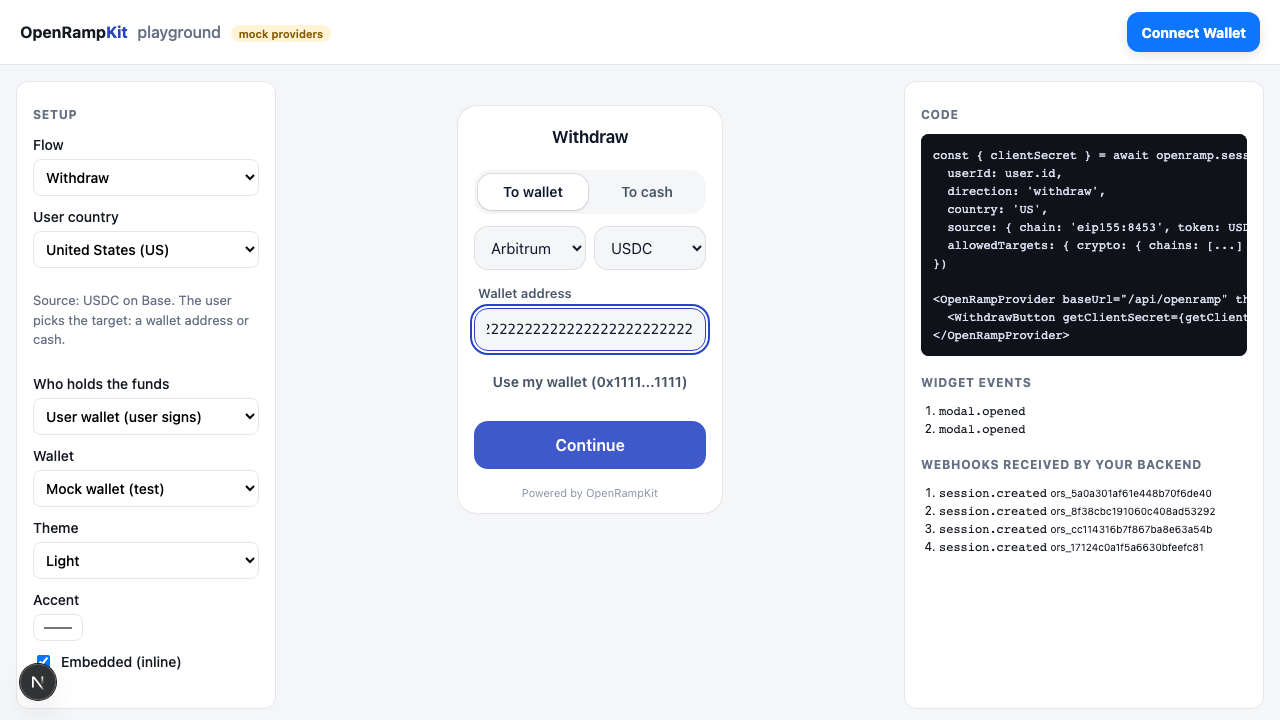
withdrawTabs() | The tabs the app allows: 'crypto' ("To wallet") when allowedDestinations.crypto is set, 'cash' ("To cash") when allowedDestinations.fiat is set, 'lightning' ("To Cash App") when allowedDestinations.lightning is set, and crypto and cash without allowedDestinations. With no tab, start() shows DESTINATION_NOT_ALLOWED. A locked target gives one tab. |
lockedTarget() | The target that the app set and locked (session.destinationLocked), else undefined. With a locked target, start() does not show the target screen and never calls /target. It gets the plan with /plan and shows the methods (or the amount screen when one wallet method is available). setTab() keeps the tab of the locked target, and back() from the amount screen goes to the methods. See Locked targets. |
withdrawChains() | The networks for "To wallet": allowedDestinations.crypto.chains, else every chain with a known USDC address plus the source chain |
targetTokens(chain?) | Token choices for a chain: USDC when known, the native token, and the source token on the source chain |
setTargetChain(chain) | Picks a network. The token becomes the source token on the source chain, else USDC, else native. The native token stays native. |
setTargetToken(token) | Picks a token from targetTokens() |
setTargetAddress(address) | Sets the address (trimmed) |
setLightningAddress(v), submitLightningTarget() | "To Cash App": keep the $cashtag or Lightning address (snapshot.lightningAddress), check its format (parseLightningTarget), send it to the server, and show the methods (or the amount screen when one method is available). Emits target.selected with { type: 'lightning', cashApp }. |
submitTarget() | Checks the address format (isValidTargetAddress), sends the target to the server, and shows the methods. When only one method is available, it selects it and goes to the amount screen. Emits target.selected. |
sourceBalance() | The wallet balance of the session's source token, when the wallet reports it |
The "To wallet" form starts on the source chain (when allowed), with the connected wallet address. The "To cash" tab pays out in the local currency of the session country, or the first allowed currency. The amount is always in the source token.
isValidTargetAddress(chain, address) and withdrawTokens(chain) are also exported.
Polling
When the step has an AWAIT transition, the controller polls GET /sessions/:id/step with the step's PollSpec: the delay starts at intervalMs, grows by backoff per attempt, is capped at maxIntervalMs, and polling stops after giveUpAfterMs. A poll answer that raced with a user action is dropped.
Snapshot
type Snapshot = {
  screen: 'loading' | 'target' | 'methods' | 'exchanges' | 'deposit_address' | 'history' | 'amount' | 'quotes' | 'step' | 'result' | 'error'
  direction?: 'deposit' | 'withdraw' // from the session once loaded
  tab: 'crypto' | 'cash'
  session?: PublicSession
  plan?: PlanResult
  method?: MethodOption
  amount: string
  amountSide: 'source' | 'destination'
  quotes: PublicQuote[]
  quoteErrors: OpenRampError[]
  quotesLoading: boolean
  selectedQuoteId?: string
  busy: boolean              // an action is in flight
  error?: OpenRampError           // the last error, or the step's error
  walletConnected: boolean
  walletAddress?: string
  balances: WalletBalance[]  // balances above zero
  source?: { chain: string; token: string; symbol?: string; decimals?: number }
  surfaceClosed: boolean     // the provider iframe said the user closed it
  target?: { chain: string; token: string; symbol: string; decimals: number; address: string } // withdraw: the "To wallet" form
  cashCurrency?: string      // withdraw: the payout currency of the "To cash" tab
  history?: HistoryItem[]    // the user's history (server option `history`); undefined when not offered
  historyLoading?: boolean
  historyError?: OpenRampError // a reload on the history screen failed
}| Screen | When |
|---|---|
loading | Starting or re-planning |
target | Withdraw: the "To wallet" form (network, token, address) |
methods | The plan is ready. The tab is cash for merchant sessions or when no crypto method is available. |
amount | A method was picked |
quotes | Quotes are loading or shown |
history | The user's past sessions (openHistory()) |
step | A payment is in progress (a non-terminal step) |
result | A terminal step: COMPLETED, FAILED, EXPIRED, REFUNDED or BLOCKED |
error | The session could not load |
When the step goes back to SELECT_METHOD (after restart), the controller clears the method and quotes and plans again.
The default source token is the largest wallet balance, else USDC on Arbitrum, Base or Optimism (not the destination chain).
createMockWallet(options?)
A fake WalletAdapter for development and tests. See Testing with mocks.
| Option | Default | Description |
|---|---|---|
address | 0x1111...1111 | Returned on eip155:8453 |
balances | 250 USDC on Arbitrum, 40 USDC on Base | WalletBalance[] |
delayMs | 600 | Delay before sendTransactions resolves |
onSend | none | (chain, txs) => void |
canSign | false | Add signTypedData, which returns a random signature (for the mock adapter; a real server refuses it) |
The returned object also has sent: Array<{ chain, txs, hash }> and signed: Array<{ chain, data, signature }>.
Re-exported types
HistoryItem, MethodOption, PlanResult, PublicLegQuote, PublicQuote, PublicSession, Step, WalletAdapter, WalletBalance from @openrampkit/core; ClientOptions, OpenRampClient, ControllerOptions, ScreenName, Snapshot, SurfaceSignal, Tab, TargetDraft.